~Crafting Historical Arguments from Historical Evidence~
Reflection:
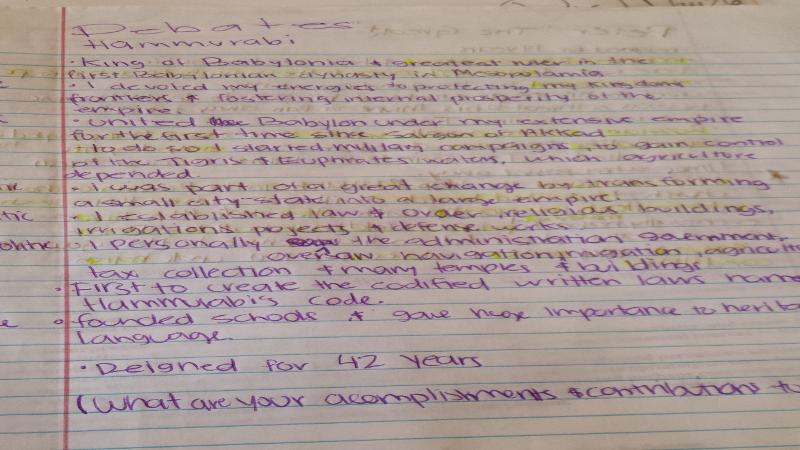
This AP skill required us to be able to contradict or to favor a statement by using historical evidence that we learned either by the book or by the power point Mr. Rodriguez explained to us. An exercise that helped me strengthen this skill is the March Madness debates. My ruler for the debate was Hammurabi, I had already learned about him at the beginning of the school year but didn't remember much about him and his contributions. I had to do a research about my ruler and my opponent Peter the Great. I needed historical evidence to prove that I was an efficient ruler than my opponent. Though, we had to put the information in our own words so we could demonstrate our understanding of what we were talking about. It wouldn't make much sense if we just talked from the information of our character if we couldn't really explain it. I had to become my character, so I spent various hours studying the accomplishments and the bad traits of Hammurabi, so I could defend myself during the debate. I found many weak points of Peter and tried to tie them to the fact that he lacked of authority. Not only in my debate I got to review rulers from the past but my classmates debate did include a good amount of information to historically prove they were better rulers. Though, sometimes a person would win only because he or she wouldn't let the other person talk, it was an unfair debate because the opponent couldn't even speak. Also, not only did you need to research your ruler but you needed to understand the event that were happening at the time and use it to your advantage to prove your ruler powerful and efficient.
Evidence: The evidence that proves my skill that I learned as a historical argumentation are my debates notes, because they helped me win my debate for the first round against Peter the Great. At first, I didnt quite know how to organize my notes and during the debates I had long seconds of silence because I couldn't find anything useful at the moment. So, for my second round I divided my paper in four to distribute SPICE, that is, except the "I".
~Chronological Thinking~
Reflection:
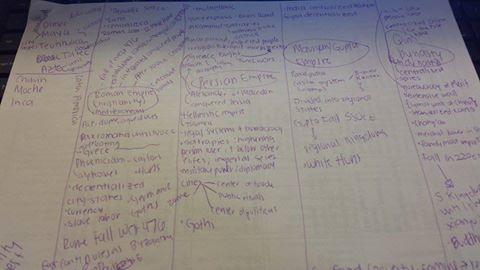
Another skill that we enhanced this year was chronological time period placement. We would use these skills in Change Over Time essays because in order to write this type of essay you must know the changes and continuities of certain regions or civilizations and you had to explain why. Mr. Rodriguez would always insist in starting this type of essay with a time line including the time period of the prompt, then we would associate all of the mayor event that placed in that time period. After we could connect the thing that didn't change to those who did change and the reason why. He really recommended to make a timeline for our essay so we could get extra point for the essay on the AP exam because we would have a broader understanding of how things changed by the event happening globally at the time. This really helped me have a better understanding of the events that we studied, it was easy because you remembered on date and a whole web of other event occurred after or before it. The Chinese Dynasty Song also, helped me very much during the test. I would sing it so I could remember it and with estimation I would give myself and idea of what was happening at the time. It was all very helpful in the end when it came to take the test, because that is what you had been studying for since you entered the classroom.
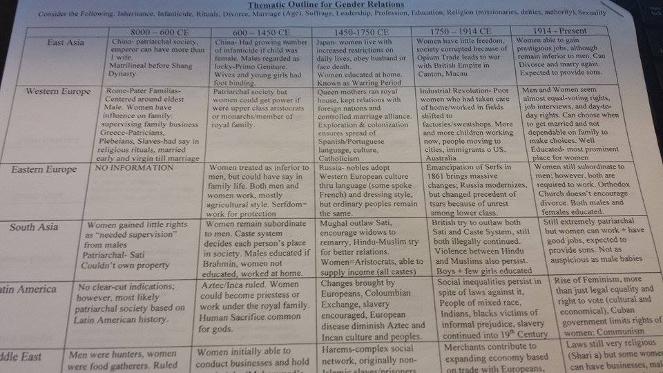
Evidence: My evidence is a packet that Mr. Rodriguez gave us before the AP exam, regarding gender roles between the years 800 CE to the Present (which is a long time). This really helped me because in our Mock AP Exam one of the essay prompt was to explain women's role between two different societies in different time periods.
~Historical Interpretation and Synthesis~
Reflection:
At the beginning of the year, Mr. Rodriguez assigned us a section to read each day (weekends 2 sections). At first I would read just enough to fill the page with notes. Before the first semester ended I realized that I needed to start taking things seriously if I intended to pass the AP Exam, so I had to convince my parents to not get mad at me when I stayed late at night reading a section and making synthesis notes to understand the topic. Mr. Rodriguez always told us to read first and then take notes, because if not we wouldn't understand what we were reading because we would be to focused on finishing our notes rather than understanding the material. What would help me the most was reading a paragraph and making bullet point with the most important information of that, mostly dates, events and important people. Other times I would write a mini-reflection of the picture in the section and try to tie it with the section. As an Interpretation skill, the DBQ essay helped me interpret documents and to figure out the point of view. Since it gave us various documents we had to interpret the attitude or actions that people took toward a historical event or tensions between regions. It was very easy because all the information was on the documents and you only needed to pay close attention to the documents and group them so they can match a similar category with the prompt given.
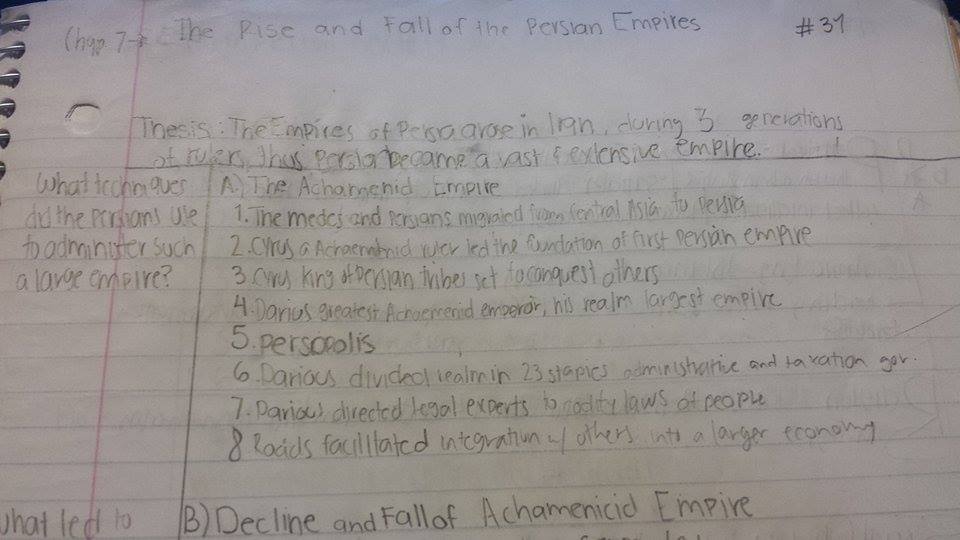
Evidence: My evidence of synthesis skills are my notes that I took regarding the Persians.These were the first notes that I took in class and they helped me because I would read the section and then summarize what seemed important to me. I would also make side notes on the margin so if I had to look back to my notes or I would create questions so that the answer could be found in the paragraph of notes,and I didn't have to read everything and I could easily find what I needed.